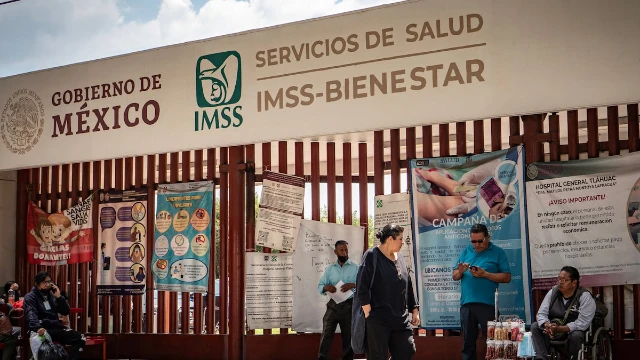
There’s a post going around in expat groups that says something like:
“Starting in 2027, you’ll be able to go into any hospital in Mexico and get covered.”
It sounds amazing. It also sounds… a little too good to be true.
Because it is.
What the Mexican government actually announced is a new public healthcare reform called the Universal Health Service or Sistema Universal de Salud in Spanish. And while it’s a real policy with real implications, it’s also being widely misunderstood—especially by foreigners trying to figure out whether they can skip private insurance altogether.
So let’s break it down properly.
What Is Mexico’s “Universal Health Service”?
In April 2026, President Claudia Sheinbaum signed a decree to create what’s being called the Servicio Universal de Salud.
The idea is simple on paper: make Mexico’s fragmented public healthcare system feel like a single network.
Right now, public healthcare is split across different institutions:
- IMSS — for private sector employees
- ISSSTE — for government workers
- IMSS-Bienestar — for uninsured populations
Historically, if you were affiliated with one of these, you were mostly limited to that system. The reform aims to change that.
Under the new model, patients would eventually be able to receive care across these institutions, regardless of where they’re registered.
That’s the key word: across the public system.
Not just “anywhere”.

Who Actually Qualifies?
The reform is designed primarily for:
- Mexican citizens
- Legal residents with proper documentation
That includes foreigners who have:
- Temporary or permanent residency
- A valid CURP (Mexico’s national ID number)
- Registration within the public system
If you’re living in Mexico full-time and properly documented, yes—you are eligible to participate.
But if you’re:
- Visiting on a tourist visa
- Spending part of the year in Mexico
- Living here informally without full residency
Then this reform doesn’t apply to you in any meaningful way.
And even among expats who do qualify, there’s another reality: Being eligible doesn’t mean it works the way you think it does.

What the Reform Actually Covers (Starting in 2027)
According to the implementation timeline shared by Mexico’s Health Ministry, the Universal Health Service won’t launch as a fully open system from day one.
Instead, it will roll out in phases—starting in January 2027.
Phase 1 — Starting 2027
The first phase focuses on a specific set of high-priority conditions and situations that will be treated across institutions, regardless of where the patient is originally registered.
These include:
- Emergency care and continuity of hospitalization
- High-risk pregnancies
- Heart attacks and strokes
- Breast cancer diagnosis and treatment
- Ongoing treatment for chronic conditions like cancer and kidney failure
- Universal access to vaccines across all public institutions
The official goal, as stated by President Claudia Sheinbaum, is that:
“Any Mexican should be able to receive care for any condition at any public health institution and be admitted.”
That’s the vision. But again—it applies to public institutions, not private ones.
Phase 2 — Second Half of 2027
Later in 2027, the system is expected to expand into shared specialized services between institutions.
This includes:
- Laboratory testing
- Imaging (X-rays, MRIs, etc.)
- Radiotherapy and other specialized treatments
The idea here is efficiency.
Instead of duplicating resources across institutions, the system would allow patients to access whichever facility has availability—regardless of affiliation.
It’s a logistical improvement more than a structural one.
Phase 3 — 2028 and Beyond
By 2028, the plan aims to go further into full system integration, including:
- Filling prescriptions at any public institution
- Cross-institution referrals for specialist consultations
- Standardized primary care for chronic diseases like diabetes
At that point, the system starts to resemble a more unified national network.
The Gap Between Vision and Reality
On paper, this sounds like a major upgrade. And in some ways, it is. But there’s an important distinction to keep in mind: This is about integration, not transformation.
The reform connects existing institutions—it doesn’t rebuild them.
So while access may improve, the underlying limitations of the public system—capacity, infrastructure, wait times—don’t disappear. And that distinction matters a lot when you’re deciding whether you can rely on it.

What It Does NOT Mean (The Biggest Misconception)
Let’s address the biggest myth directly.
No—you will not be able to walk into any hospital in Mexico and get treated for free.
Here’s what the reform does not include:
❌ Access to private hospitals
❌ Free choice of any doctor
❌ Immediate, on-demand care
❌ A universal system comparable to top-tier healthcare abroad
What it actually creates is portability within the public system.
A simple way to think about it: You’re not gaining unlimited choice—you’re gaining flexibility within a fixed network.
And that network is made up of public hospitals, with all the strengths and limitations that come with them.

Public vs Private Healthcare in Mexico — The Reality Expats Learn the Hard Way
On paper, public healthcare sounds like a solid safety net. And to be fair, it is—especially for certain types of care.
But there’s a reason most nationals don’t like it and many expats eventually look elsewhere.
Public healthcare in Mexico involves:
- Long wait times
- Overcrowded facilities
- Limited equipment
- Administrative friction
Private healthcare, on the other hand, operates very differently. Hospitals like Hospital ABC or Hospital Ángeles offer:
- Immediate access
- Wide choice of specialists
- Consistent infrastructure and service quality
- Shorter timelines from diagnosis to treatment
It’s not that one system is “good” and the other is “bad.” They serve different purposes.
- Public healthcare is designed to provide broad access.
- Private healthcare is designed to provide speed, control, and consistency.
And for many expats—especially those used to private systems in the U.S., Canada or Europe—that difference becomes very noticeable, very quickly.

So… Should Expats Rely on It?
If you’re:
- Young
- Healthy
- Comfortable navigating public systems
- On a super tight budget
Then the public system—including this reform—might be enough as a backup.
But if your expectations include:
- Choosing your doctor
- Avoiding long wait times
- Having predictable access to care
- Getting treated in top-tier facilities
Then this reform doesn’t replace private insurance.
It doesn’t even try to.
A more realistic way to frame it is: It reduces gaps within the public system—but it doesn’t eliminate the need for private options.
And that’s why, despite the headlines, the behavior hasn’t changed.
Sounds good in theory. In practice, most expats still rely on private care.

What Most Expats End Up Doing Instead
For people who plan to stay in Mexico long-term, the solution usually isn’t choosing one system over the other.
It’s combining them.
A common approach looks like this:
- Use the public system as a fallback
- Build a financial buffer for smaller expenses
- Add private insurance for major or time-sensitive care
This hybrid strategy gives you flexibility without forcing you to rely entirely on one structure.
Because at the end of the day, healthcare decisions aren’t about what’s theoretically available. They’re about what you can actually access when something goes wrong.

Final Thoughts
Mexico’s new healthcare reform is a meaningful step in the right direction—for the public system.
But it’s not a shortcut to unlimited, high-quality, on-demand care. And it definitely doesn’t mean you can walk into any hospital you want and expect to be covered.
If you’re an expat trying to make a decision based on that assumption, it’s worth slowing down and looking at how things actually work on the ground. Because the difference between expectation and reality is exactly where most costly mistakes happen.
At Donna, we can help you get the right coverage, message us on WhatsApp or fill out this form and let’s start today!
Learn more:


